Introduction
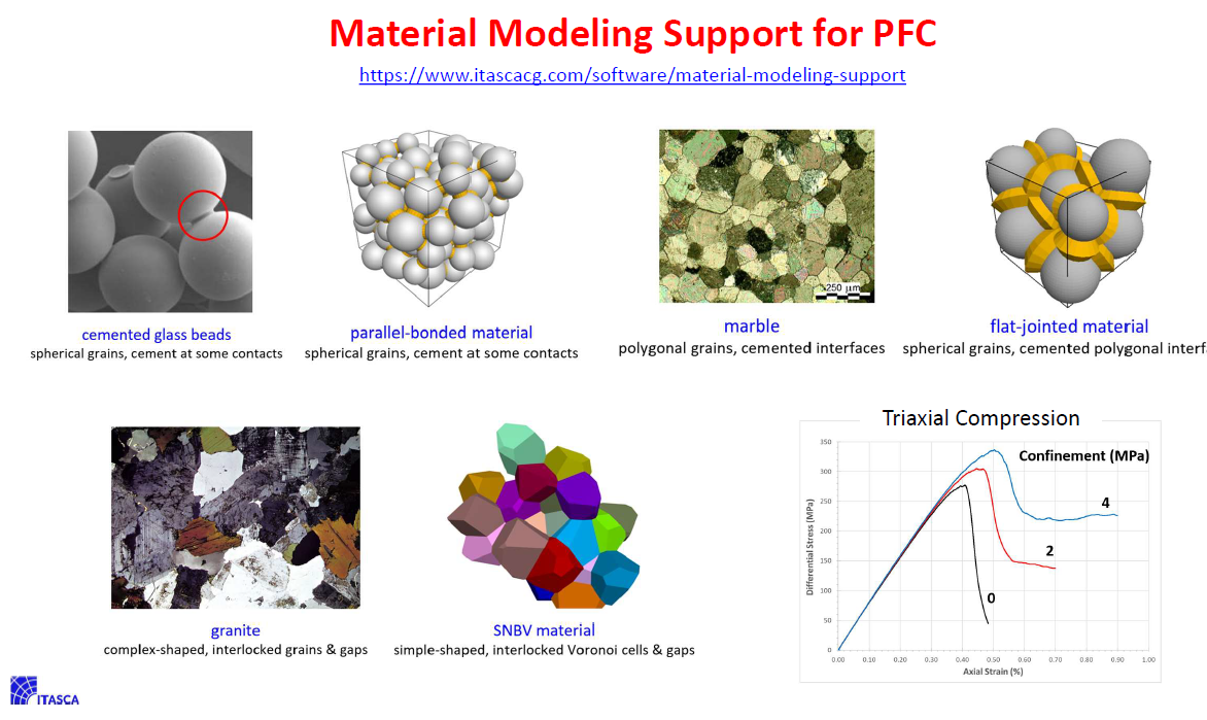
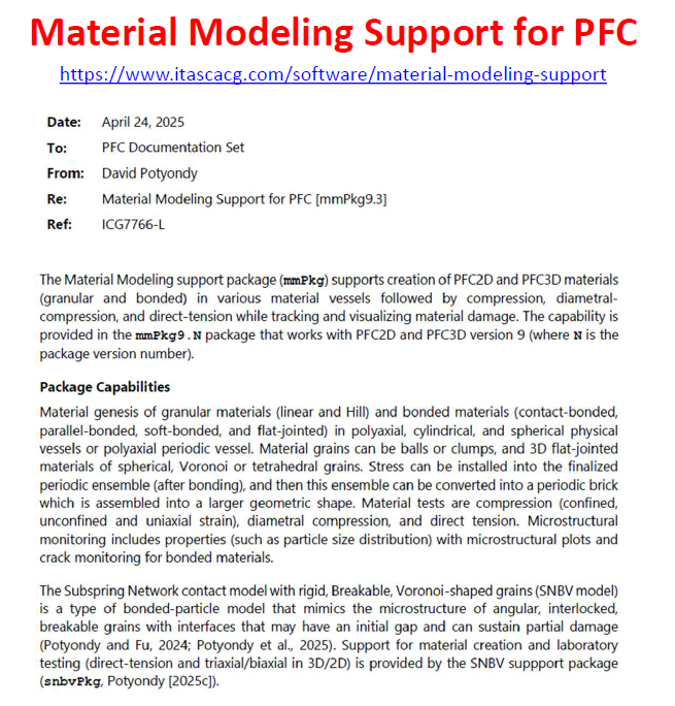
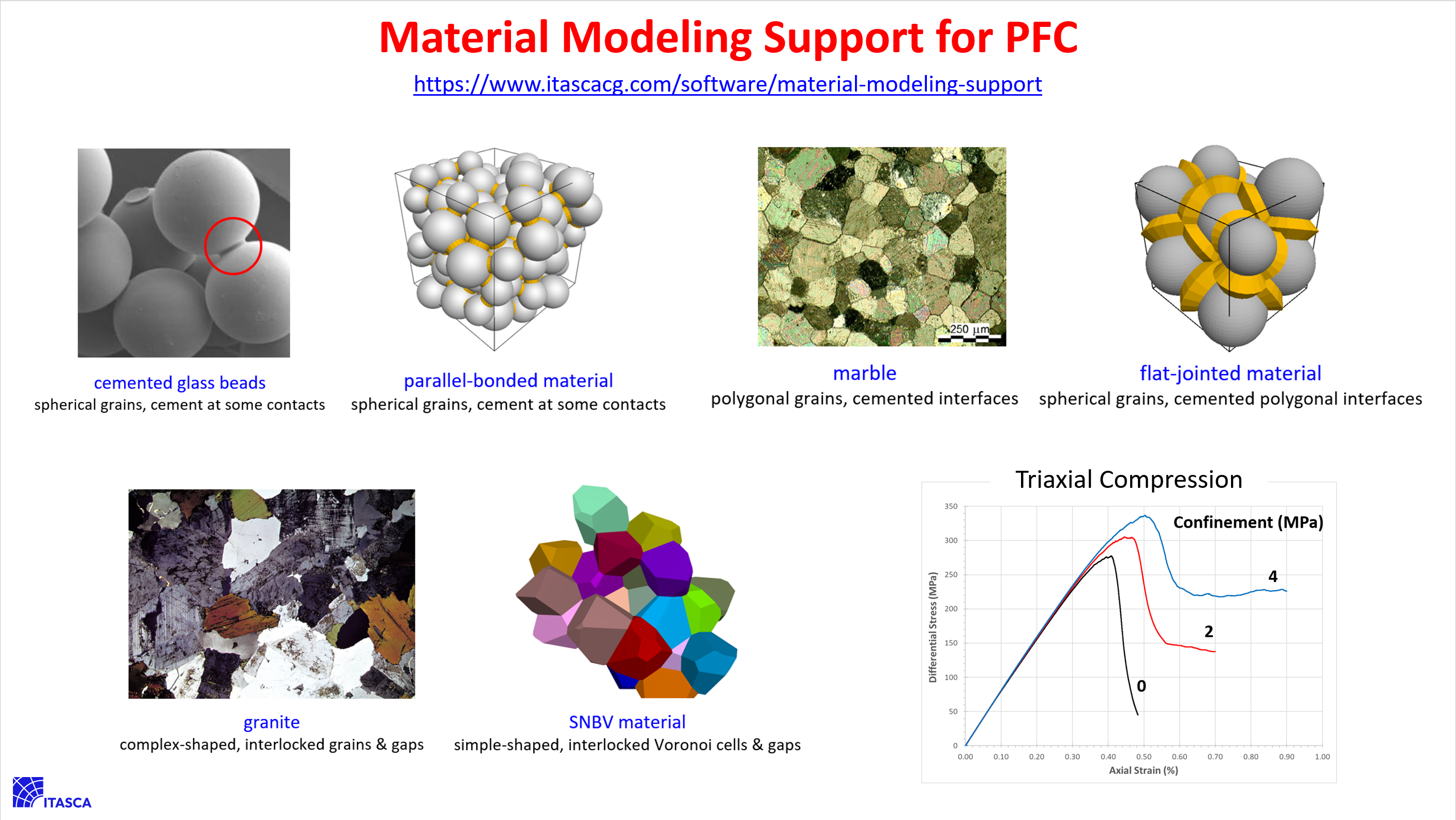
The PFC model provides a synthetic material consisting of an assembly of rigid grains that interact at contacts.1 This synthetic material encompasses a vast microstructural space, and only a small portion of this space has been explored. For example, the bonded-particle modeling methodology provides a rich variety of microstructural models in the form of bonded materials (Potyondy, 2015; Potyondy and Cundall, 2004). Potyondy et al. (2025) expands the definition of a bonded-particle model and situates it with the broader context of microstructural rock models, of which it is one example. The PFC model includes both granular and bonded materials as well as an interface that can be inserted into the bonded materials. The support for material modeling that is provided for PFC2D and PFC3D is described in this document. The material-modeling support is provided in the form of a consistent set of FISH functions, which we call the material modeling support package (or mmPkg).2 The mmPkg provides a state of the art embodiment of six well-defined materials to support: practical applications (via boundary-value models made from these materials), and scientific inquiry (via further exploration of the microstructural space described above).
The Subspring Network contact model with rigid, Breakable, Voronoi-shaped grains (SNBV model) is a type of bonded-particle model that mimics the microstructure of angular, interlocked, breakable grains with interfaces that may have an initial gap and can sustain partial damage (Potyondy and Fu, 2024; Potyondy et al., 2025). Support for material creation and laboratory testing (direct-tension and triaxial/biaxial in 3D/2D) is provided by the SNBV support package (snbvPkg, Potyondy [2025c]).3
Download the Material-Modeling Support Files
1Particles in the PFC model interact at contacts by means of a generalized internal force. Contact mechanics is embodied in particle-interaction laws that employ a soft-contact approach for which all deformation occurs at the contacts between the rigid bodies. The particle-interaction laws are referred to as contact models. The PFC contact models are described in ITASCA (2025a, PFC - Contacts and Contact Models).
2The material-modeling support package can be downloaded HERE. The package for PFC 5.0 uses the naming convention fistPkgM, where M is the package version number. The packages for PFC 6.0 to 9.0 use the naming convention fistPkgN.M, where N is the PFC version number and M is the package version number. The name fistPkgN.M was replaced with mmPkgN.M in March 2025. Material-modeling support may be provided in future versions of PFC by embedding the material-modeling capability directly into the command set of the PFC programs.
3Two additional packages to perform an oedometer test on dry sand (otPkg9.2, Potyondy [2025a]) and model biocemented sand (csPkg9.1, Potyondy [2025b]) and are also available.
Publications
Potyondy, D. 0., Fu, W., Purvance, M., & Mas lvars, D. (2025). A 3D subspring network breakable voronoi model for rock. Rock Mechanics and Rock Engineering, https:/ /doi.org/10.1007 /s00603-025-04655-w [view-only version https:/ /rdcu.be/eqfrE]
Potyondy, D. (2025a). Oedometer test package for PFC3D [otPkg9.2]. Itasca Consulting Group, Inc., Technical Memorandum 5-8006:25R19 (April 16, 2025). [Contact David Potyondy to obtain the package.]
Potyondy, D. (2025b). CS Support (Cemented Sand model) for PFC2D [csPkg9.1]. Itasca Consulting Group, Inc., Technical Memorandum 5-8006:25R18 (April 7, 2025). [Contact David Potyondy to obtain the package.]
Potyondy, D. (2025c). SNBV support (subspring network breakable voronoi model) for PFC [snbvPkg9.2]. Itasca Consulting Group, Inc., Technical Memorandum 5-8106:25TM06 (April 1, 2025). https://www.itascacg.com/software/snbv-support-for-pfc
Potyondy, D. O. (2015). The bonded-particle model as a tool for rock mechanics research and application: current trends and future directions. Geosystem Engineering, 18(1), 1–28. https://doi.org/10.1080/12269328.2014.998346
Potyondy, D. O., & Fu, W. (2024). A 3D subspring network breakable voronoi model for rock: laboratory-scale behavior. In Proceedings of the 58th US Rock Mechanics/Geomechanics Symposium, Paper ARMA 24-493. American Rock Mechanics Association. https://doi.org/10.56952/ARMA-2024-0493
Potyondy, D. O., & Cundall, P. A. (2004). A bonded-particle model for rock. Int. J. Rock Mech. & Min. Sci., 41(8), 1329–1364. https://doi.org/10.1016/j.ijrmms.2004.09.011